


Practice
Meditation Method
GSY involves mental chanting of a divine mantra and meditation. With regular practice, the chanting becomes involuntary.
The practice at a glance
- Twice a dayMorning and evening, at least
- 15 minutesEach meditation
- Silent chantingMentally, lips and tongue still
- Any placeAny time, facing any direction
- Empty stomachOr two hours after a meal
Part 1
Method of Meditation
Step by step guide to meditation
Practice of GSY basically involves meditation and silent (mental) chanting of mantra given by Guru Siyag. The meditation must be done at least twice a day for 15 minutes each. The mantra must be chanted silently (mentally repeated; soundlessly without moving lips and tongue) during meditation and also throughout the day while going about routine activities. The meditation and chanting together awaken the dormant Kundalini, an energy force in the practitioner’s body, which induces involuntary yoga Asana, kriyā, bandh, pranayam and mudrā.
The step-by-step method of meditation is as under:
- Sit in a comfortable position.
- You can sit cross-legged on the floor, sit on a chair / couch, lie down (if unable to sit) etc., to meditate.
- Look at Guru Siyag’s picture for a minute or two until you remember the image. You can use any image of Guru Siyag. The quality of the image (black & white, printed, soft copy etc) does not make any difference to the meditation.
- Then close your eyes and say silently to Guru Siyag, “Help me meditate for 15 minutes.”
- Then, with your eyes still closed, think of Guru Siyag’s image at Āgyachakra – the centre of the forehead (a little above the space between eyebrows). This spot is also known as the third eye. In other words, you have to try to imagine Guru Siyag’s picture in your mind and focus that image at the center of your forehead.
- While thinking of the image, repeat silently (chant) for 15 minutes the mantra given by Guru Siyag.
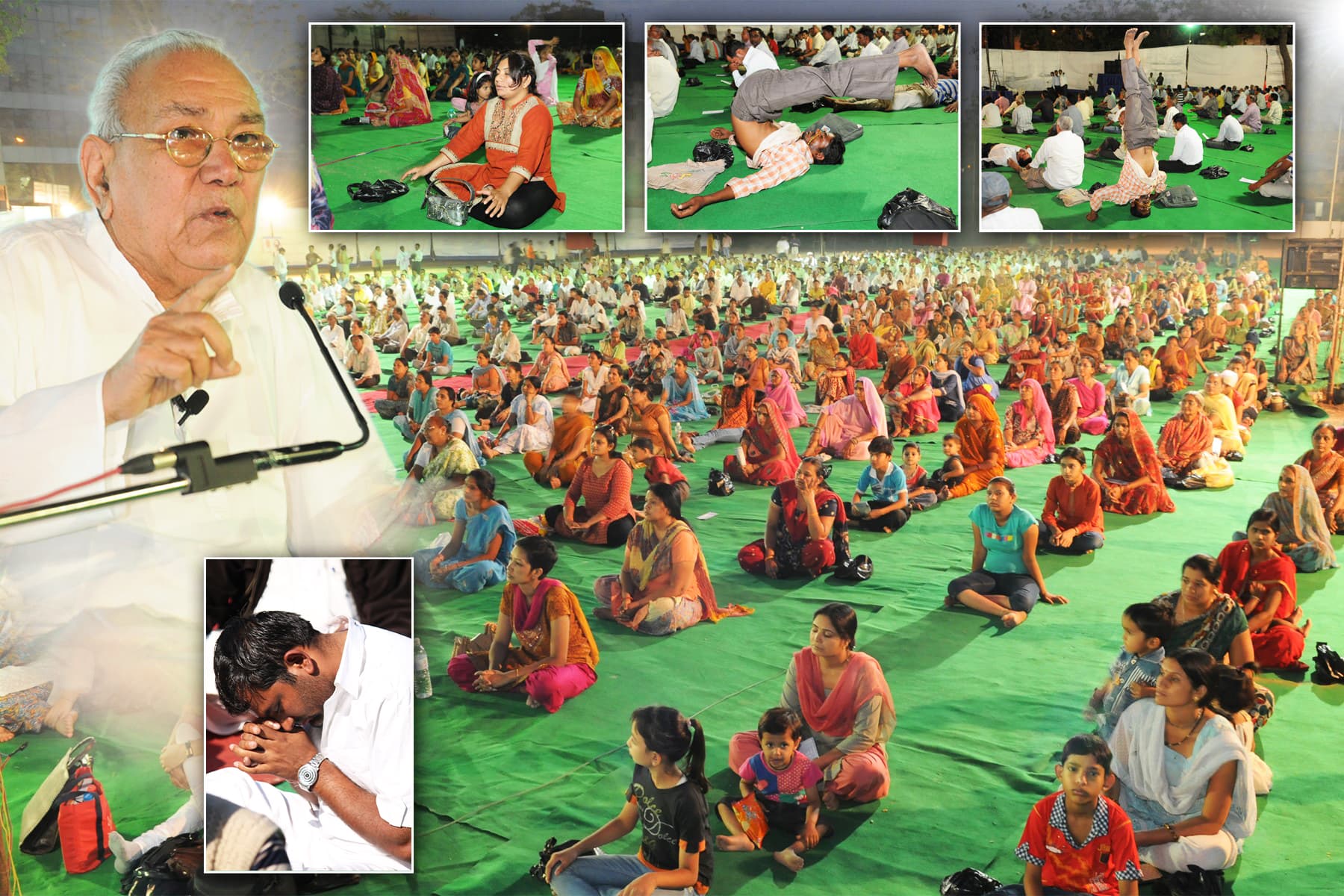
- During meditation, you may experience certain automatic yogic postures or movements in your body. Swaying, nodding of head, rapid movement of head from left-to-right or vice versa, inflating or deflating of belly, clapping, grunting, moaning or laughing can happen in many cases. Do not panic or worry. These involuntary actions are ordained by a divine force, and they are needed for your internal cleansing and to ready you for further progress.
- You may also experience vibrations, see bright lights, colors or even have visions or revelations of the past and future events. These are indications that you are progressing well on the spiritual path.
- However, if you do not experience any yogic postures or see visions, it does not mean that you are not making progress. In all probability, the divine force awakened in you has perhaps decided that you don’t need these experiences.
- You will notice that your meditation will come to an end exactly when you reach the time limit you had set. For further queries email gssyworld@gmail.com or call (+91)8369754399
Please keep in mind the following key points during meditation:
- Make sure you are comfortable and relaxed because it will allow various yoga āsana, kriyā, bandh, mudrā and prānāyām induced by awakened Kundalini to happen freely without obstruction.
-
Keep your eyes closed during meditation.
- The meditation can be done at any time of the day and in any place you find suitable. You can face any direction.
- Meditate on an empty stomach or two hours after you have consumed a meal. Meditating immediately after a meal will make you sleepy and you may doze off during meditation. Rapid involuntary yogickriyā may make you feel nauseated if you have eaten right before meditation.
- If you are not able to imagine Gurudev’s image at Āgyachakra for all 15 minutes of meditation, don’t worry about it. Try to imagine the picture for a couple of minutes. If after that the image fades away, simply keep focusing at the Āgyachakra and chant the mantra.
- Having thoughts during meditation is perfectly natural. The more you chant the mantra throughout the day, the more focused the mind becomes about the spiritual practice. This in turn means that you will not be troubled by thoughts during meditation. When thoughts do occur, don’t break your meditation. Continue with it, and your mind will settle down after a while. Also, with regular practice, your concentration will improve.
- During meditation you may also have various other experiences in the body like vibrations, sensation of electric current running along the spinal column, gyrating, leaning forward or backward, rolling on the ground, rapid movement of the head, clapping, shouting, crying, laughing, singing etc. You may also experience seeing bright lights, sensing fragrant smell, hearing tinkling of bells or thudding of drums, thunder etc. In exceptional cases, you may also see some frightening scenes like floods or earthquakes, etc. Do not break your meditation due to excitement, joy or fear. DivineShakti Kundalini is inducing these experiences to cleanse your body and mind and free you from diseases/ addiction etc and thus ensuring your spiritual progress.
- If you do not experience any of the above yogic movements or sensations, do not break your meditation. Absence of these experiences does not mean you are not making progress. Sometimes, these experiences begin occurring after a few days or months of regular spiritual practice.
- Meditating at least twice daily is the key to progress.
- Meditating without chanting of the mantra will not give any result. Chanting of mantra during meditation is a must.
- The mantra should be chanted round-the-clock. This means the practitioner should chant it during routine activities like brushing teeth, shaving, bathing, eating breakfast / lunch / snacks /dinner, commuting to office in bus, train, car etc., and working in the office or at any field site or even when watching TV at home. In short, chant the mantra relentlessly as much as you can.
- If you are speaking to someone, you may find it hard to chant the mantra but resume it again when the conversation is done.
- Since chanting of mantra is to be done silently (mentally) without moving tongue and lips, it will not cause you any social discomfort. The chanting will not disturb anyone around you in the office, outside or at home.
-
When you chant the mantra continuously like this for four to five weeks, the chanting becomes involuntary. This state is calledAjapa Jāpa — the chanting that happens without any effort on the part of the practitioner. When you reach this stage, you don’t have to chant the mantra; your guru takes over that duty on your behalf.
Part 2
Get Mantra
How to receive the sacred mantra
Receiving the mantra is a two step process:
- Watch the 7-part video of Guru Siyag’s pre-mantra diksha discourse. Pre Mantra Videos
- Send an email to gssyworld@gmail.com with the subject ‘Mantra Request’. In the mail please confirm that you have watched the pre-mantra diksha discourse.
Once your email is received, a video and audio clip of the mantra will be sent to you in the next couple of days. For further queries email gssyworld@gmail.com or call (+91)8369754399 or whatsapp on (+91)9468623528
Part 3
Thoughts During Meditation
Managing thoughts while meditating
Mind is filled with thoughts during meditation.
Question: I’m unable to meditate, have endless thoughts during meditation. My mind even thinks of those things that normally don’t occur to me.
The answer to this question has many aspects but let us first clear up one basic concept:
The idea that the mind should become thoughtless during meditation is a near myth. The mind will become thoughtless but gradually over a period of time and after many years of meditation, at a higher stage of consciousness. The immediate purpose of meditation is not to make the mind thoughtless, rather it is to quieten the mind down. This process of quieting the mind can be understood with an analogy: let’s say there is dirt in a glass of water. The dirt keeps swirling around. If you stir or shake the glass, the dirt swirls even faster. If you leave the glass undisturbed, then after a few hours the dirt will begin to settle down at the bottom of the container and only clear water will be visible. Regular meditation quietens the chaos of thoughts in your mind – your thoughts, ideas and reactions settle down, revealing clear unmuddled vision.
Now coming to the heart of the question – why do thoughts occur during meditation nand how can these be curbed?
When we meditate, can you stop your ears from hearing sounds? Can you prevent your nose from smelling things? If there is a sudden sound or a whiff of fragrance when you are meditating, can you stop your ears and nose from registering this stimulus? Much in the same way, the job of the mind is to create thought. This function of the mind cannot be controlled. However, it can be slowed down.
This brings us to the next part of the question: Why does the mind create so many thoughts during meditation and why do we think of those things that would normally not occur to us?
Let us approach this question with two analogies:
You may have seen pictures of icebergs and also know a little bit about them – they are ice structures that seem to be floating in water. The portion of the iceberg that we see above water is only 10% to 15% of its actual size. The remaining mammoth structure is submerged under water and remains invisible to us. Is it the above-surface small part of the iceberg that propels its movement or is it the submerged gargantuan one? It’s obviously the submerged portion of the iceberg that guides the movement of the whole structure. Even if it’s not visible, it is the submerged mass that controls the movement of the visible one.
Similarly, 90% of our mind is subconscious while only 10% is conscious. Which part of the mind guides our behaviour then? It is certainly the subconscious. This is why after a particularly perplexing incident we say, I don’t know why I did this? I didn’t intend to do this and yet I did it. I meant to say one thing and said something else altogether. Where did these uncontrolled behaviours and words emerge from? They rose from that subconscious center that is not visible to anyone. Now keep this in mind that roughly only about 10% of our thoughts and actions are under our control, we have no control over the other 90%.
Now for the second analogy:
Say you are in a public place talking to a friend. After a while if you are asked about the conversations around you, you will likely say that you were aware of people talking but didn’t know exactly what they were saying. You may also add that even though you could hear snippets of these conversations, your mind didn’t register them because you were focused on your own conversations with your friend. Now in this same scenario, if you are asked to sit quietly for a bit would you then be able to hear the conversations? You would not only be able to hear the conversations but give clear accounts of them – someone was talking about the construction of their new home, someone about a movie, someone about their relationship and so on. Why were you able to hear these conversations now and not before? Because you sat quietly and observed.
Much in the same way, the 10% of your mind that is conscious quieted down as soon as you began meditating. This made it fully aware of the noise and chaos that the 90% subconscious mind was creating. This endless barrage is present 24 hours a day but we become aware of it only when we are meditating. This is why it suddenly feels like you have thoughts that you normally wouldn’t have.
Once you become aware of these subconscious thoughts and persist with the meditation practice, over a period of time your mind will quiet down and reach a state of stillness. In this state, you will be able to meditate as easily in a noisy market as you would in a quiet place. This state of consciousness will be made possible only because of your quiet inner center